Overview & Quick Facts
The Naglieri Nonverbal Ability Test (NNAT) measures nonverbal reasoning using geometric shapes and patterns — no language, numbers, or reading required. Used for gifted screening in grades K–12.
Quick Facts
4 Question Types
Key Takeaway
NNAT is a pure nonverbal test. Children who are English language learners or have strong visual-spatial abilities often perform differently here than on language-based tests like the CogAT.
How to Use This Guide
Use the chapter navigation on the left to explore each section in depth. Start with a specific question type to understand what's tested, then jump to the 4-Week Study Schedule when you're ready to prep.
Pattern Completion
A section of a design is missing. The child selects which of five options completes the pattern.
Key Takeaways
- ›Focus on edges and color gradients at the cut boundary
- ›The missing piece must match the pattern both horizontally and vertically
- ›Wrong answers often look plausible but break one grid line
The ability to recognize a complete image when part is missing. Practice with puzzles.
Identifying the boundary between the missing piece and the surrounding pattern.
Understanding how patterns flow across the grid — left-right and top-bottom.
Example
A rectangular grid has a missing lower-right cell. Which piece completes the diagonal pattern?
Match the diagonal pattern direction and density from the surrounding cells.
Reasoning by Analogy
A 2×2 matrix where three shapes are given; the child finds the fourth that completes the relationship.
Key Takeaways
- ›Identify the transformation from left to right in the top row
- ›Apply the same transformation in the bottom row
- ›Common transformations: rotation, size change, shading, reflection
The relationship between two shapes — not what they look like, but how they change.
Every row must follow the same rule AND every column must follow the same rule.
Wrong answers often apply a different transformation or only match one row/column.
Example
Circle : Half-circle :: Square : ___
Same relationship: the shape is cut in half. Apply to square → half-square.
Serial Reasoning
A 3×3 matrix with eight shapes and one missing. The child identifies the rule governing all rows and columns.
Key Takeaways
- ›Look for the rule in EACH row separately before checking columns
- ›Rules include: adding elements, rotation sequences, size progressions, shading changes
- ›Serial Reasoning is the hardest NNAT question type — most children struggle here
Finding consistent rules across all three rows simultaneously.
The shape might change while the size also changes — track multiple attributes.
If you can't find the rule, eliminate answers that break any visible rule.
Spatial Visualization
Two or more shapes that combine or transform. The child identifies the result of the transformation.
Key Takeaways
- ›Mentally overlay or combine the shapes before looking at answer choices
- ›Practice mental rotation — imagine spinning a shape 90° at a time
- ›Spatial Visualization questions often involve folding or combining geometric pieces
Rotating shapes in your mind — which pieces fit together when moved or turned?
Predicting what happens when shapes are moved, reflected, or combined.
Reasoning about 2D shapes without counting or measuring — pure visual logic.
4-Week Study Schedule
15–20 minutes per day, 4–5 days per week. Build skills progressively.
Week 1
Foundation
- ›Study the test format and all question types
- ›15 min practice daily — untimed
- ›Identify weak areas from practice
- ›Build vocabulary or core reasoning skills
Week 2
Skill Drills
- ›Target weakest question types with focused drills
- ›20 min practice daily with review
- ›Learn strategy approaches for each question type
- ›Begin timed sections
Week 3
Practice Tests
- ›Take first full timed practice test
- ›Analyze results by section — note patterns
- ›Double down on lowest-scoring areas
- ›Continue 20 min daily warm-ups
Week 4
Final Review
- ›Second full practice test under real conditions
- ›Review all wrong answer explanations
- ›Light review only in final 3 days
- ›Good sleep and relaxed mindset before test day
Ready to practice?
Free questions — no signup required.
Score Interpretation
NNAT scores are reported as the Naglieri Ability Score (NAS) and National Percentile Rank. The NAS has a mean of 100 and a standard deviation of 15.
Naglieri Ability Score (NAS)
Mean of 100, SD of 15. Compares to same-age peers nationally. A NAS of 125 = 95th percentile. Most gifted programs require 95th percentile or above.
National Percentile Rank
Compares to a nationally representative sample. Gifted cutoff is typically the 95th+ percentile — higher than CogAT's 90th percentile cutoff.
95th pct
Typical gifted program threshold
Grade Equivalent
Indicates the grade level whose median NAS matches the child's score. Above-grade-level scores indicate the child reasons like an older student.
Recommended Books
Affiliate links — we earn a small commission at no extra cost to you.
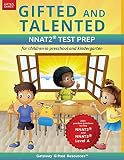
NNAT Test Prep Grade 2 Gifted Workbook
Full coverage of all four NNAT question types with timed practice tests.
Naglieri Nonverbal Ability Test Practice Tests
Official-style practice tests with answer keys and explanations.
Frequently Asked Questions
What is the NNAT?
The NNAT (Naglieri Nonverbal Ability Test) measures nonverbal reasoning ability using geometric shapes and abstract patterns. It requires no reading, writing, or math — only visual-spatial thinking.
What grades take the NNAT?
The NNAT is administered to students in grades K–12. Different grade levels take different versions (Levels A through G) to ensure age-appropriate difficulty.
What is a good NNAT score for gifted programs?
Most gifted programs require a Naglieri Ability Score (NAS) at or above the 95th percentile. The NAS has a mean of 100 and standard deviation of 15, so the 95th percentile corresponds to approximately NAS 125.
Can you prepare for the NNAT?
Yes. While the NNAT tests innate reasoning, practice with similar visual-spatial materials (puzzles, tangrams, matrices) builds familiarity with question formats and reduces test anxiety, which can improve scores.
How is the NNAT different from the CogAT?
The CogAT tests verbal, quantitative, and nonverbal reasoning. The NNAT tests only nonverbal reasoning, making it useful for identifying gifted students who may not yet have strong language skills.